Listening Guides / Books and EPUB listening
How to Read an EPUB Aloud on iPhone
Read an EPUB aloud on iPhone with Apple Books or a dedicated reader. Compare reflowable files, chapters, footnotes, import, DRM, and offline prep.
By AudioPage Editorial · Published · Updated · 10 min read
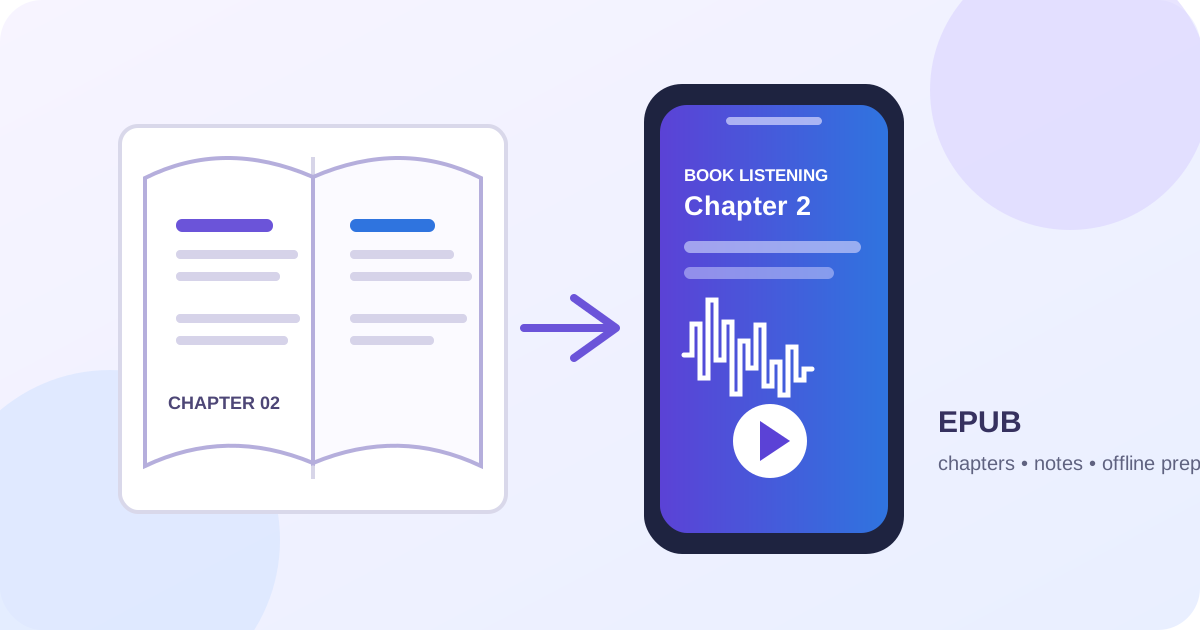
How to Read an EPUB Aloud on iPhone
To read an EPUB aloud on iPhone, open it in Apple Books and try Apple’s built-in Read & Speak tools, or import the supported file into a dedicated reader such as AudioPage. Start by checking whether the EPUB is reflowable text or a fixed-layout book. Reflowable books usually expose chapters and selectable text more cleanly; fixed-layout or image-heavy books need a page-by-page listening check. If the book is protected by a store, use the app that owns it rather than trying to copy it elsewhere.
Quick takeaway: Apple Books is enough when you mainly want to read, search, bookmark, or annotate one EPUB. A dedicated reader helps when you want to save a supported, DRM-free file as a repeatable listening item, verify chapter order, resume in a library, and prepare core playback for offline use.
Check the EPUB before choosing a reader
The extension .epub tells you the container, not the reading experience. An EPUB can be mostly text, a fixed design, a collection of scanned page images, or a protected store book. The most useful first question is whether the text can reflow when you change font size. Apple describes a reflowable EPUB as one where text size and content pagination adapt to the device; a fixed-layout EPUB keeps positions fixed and is better suited to image-heavy or multi-column designs. See Apple’s EPUB layout guidance before you treat a book as a normal text stream.
| EPUB situation | First choice | Why it fits | What to verify before a long session |
|---|---|---|---|
| Reflowable, selectable text | Apple Books or a dedicated reader | Chapters and paragraphs can adapt to the screen | Chapter names, headings, footnotes, and language |
| DRM-free file saved in Files | Share Sheet to a reader | You control the import path and can keep a listening copy | The receiving app accepts the specific EPUB |
| Fixed-layout textbook or comic | Apple Books first | Visual layout is part of the content | Text may not be a continuous speech stream |
| Store download with protection | The store’s own app | The book may be bound to its library and license | Whether that app offers spoken text or audiobook access |
| EPUB made from a document | Inspect the export settings | A clean source can preserve headings and a table of contents | Whether tracked changes, comments, and images were resolved |
Do not promise yourself that every EPUB will behave like a paperback. Tables, poetry, sidebars, endnotes, and image captions can all enter the reading order differently. A short test is more useful than a generic compatibility claim.
Option 1: stay in Apple Books
Apple Books is the simplest choice when the book is already in your library or you only need occasional reading. Apple’s Books guide for iPhone covers books and manually added content, including search, reading position, bookmarks, collections, and text selection. If the EPUB is already there, do not import it into another app just to add complexity.
For a file you received from another app, save it or open its Share Sheet and choose Books when that option is offered. The same general file-sharing route is useful for a file in Files: touch and hold the item, tap Share, and choose a destination. Apple’s Files instructions document that path for sending a file copy.
Apple Books is usually enough when:
- the EPUB is legally available in Books and opens with its chapters intact;
- you want reading, search, bookmarks, notes, or highlights more than a listening queue;
- the book’s own audiobook edition is the better match for expressive narration;
- you are comfortable using the book’s current app rather than exporting a separate speech track.
The limitation is not that Books is a bad reader. It is that a book library and a text-to-speech listening queue solve different problems. If you need to test a local voice, keep several imported documents beside web articles, or resume a speech session across a personal library, a dedicated reader may be a better workflow.
Option 2: import a supported EPUB into AudioPage
AudioPage is for supported PDFs, EPUBs, DOCX files, web articles, pasted text, and photos or scans that you want to turn into iPhone listening items. The practical import route is:
- Save the EPUB to Files or open the message that contains it.
- Tap Share and choose AudioPage if it is available in the Share Sheet.
- Wait for the document title and extracted text to appear.
- Check the beginning of the book and open the chapter list if the file exposes one.
- Choose a voice and speed, then listen to a short section before committing to the full book.
This is a local-first workflow after setup, not a promise that every EPUB is accepted or perfectly linear. The first voice setup needs internet to download the required voice resources. After that, supported core listening can continue locally offline. Free supports up to 10 saved items. Lifetime Offline covers eligible local reading features. Pro connected summary, document chat, and optional sync are separate cloud actions that require a connection when selected.
AudioPage does not turn the EPUB into an MP3 or create an audiobook-production file. It keeps the reading and listening workflow on iPhone. That distinction matters if your real goal is editing chapters, adding music, publishing an audiobook, or delivering a downloadable audio file; use a tool designed for those jobs instead.
For a broader document comparison, see our guide to reading any PDF aloud on iPhone. If a flight or commute is the reason you are preparing the book, compare the offline text-to-speech workflow before you leave Wi-Fi.
Chapters, footnotes, and reading order
EPUBs have an advantage over many PDFs because reflowable books can carry semantic structure: chapter headings, sections, links, and a navigation document. That does not make every export clean. A document-to-EPUB conversion can create a heading that sounds like ordinary body text, repeat the title before every chapter, or place footnotes immediately after the paragraph instead of at the end.
Listen to the first chapter with the screen visible. Confirm these transitions:
- the title is spoken once rather than before every page;
- the chapter heading is announced before the chapter body;
- a footnote is identified as a note rather than silently interrupting a sentence;
- a hyperlink or endnote does not cause the reader to leave the main flow;
- the table of contents leads to the expected chapter;
- a new chapter does not begin in the middle of a sentence.
If you created the EPUB in Pages, Apple recommends using paragraph styles and lets you choose reflowable or fixed layout in the EPUB export options. Its documentation also says to accept or reject tracked changes before exporting when that document contains revisions. That step is a content-cleanup step, not a text-to-speech setting: if you skip it, the speech reader may narrate editorial residue.
What “DRM-free” should mean in this workflow
Use DRM-free as a practical compatibility label, not as a promise that every EPUB can be copied. A file you created, downloaded from a source that explicitly permits file access, or received as an ordinary document is easier to test in Files and a third-party reader. A store book may be protected or tied to its owning app. Apple notes that transfers can be restricted for files protected by copyrights or stored in proprietary formats in its file transfer guidance.
If a protected book does not appear in the Share Sheet, stop there. Do not strip protection, rename the extension, or upload it to an untrusted converter. Ask the publisher for an accessible copy or use the store’s own reading and audiobook options.
The ten-minute EPUB listening test
Before a trip, study block, or long walk, test one representative book rather than assuming that the filename is enough.
Test fixture: a DRM-free, reflowable EPUB with two chapters, a footnote, one hyperlink, and a short table of contents.
- Import it from Files through the Share Sheet.
- Confirm the title, author, and first heading.
- Start at the first paragraph and listen for two minutes at 1×.
- Jump to chapter two and confirm that the heading is spoken before its first paragraph.
- Select or inspect one footnote and one hyperlink to see how the reader presents them.
- Stop halfway through a paragraph, close the reader, and reopen the item.
- Turn on Airplane Mode only after the first voice setup is complete, then play for one minute.
- Note any page image, table, formula, or endnote that still requires visual reading.
Pass the test if the file opens, the chapter order is usable, the voice is available, the resume point is understandable, and offline playback works for the supported local path. Fail it if the book is protected, headings are missing, reading order is confusing, or the voice setup was never completed.
Troubleshooting EPUB speech on iPhone
The EPUB opens but no text is selectable
It may be fixed-layout or image-heavy. Open it in Apple Books to confirm that it is visually readable, then try a dedicated reader only if it explicitly supports that layout. Do not assume OCR is the right answer for a designed book; OCR may lose chapters, captions, and typography.
The reader skips the table of contents
That can be normal for a listening flow, but confirm that the chapter destinations still work. If the table is embedded as an image, it may have no useful text structure. Use it visually for navigation and keep the chapter test as your speech test.
Footnotes interrupt every paragraph
Try the reader’s note or navigation controls, if available, or use a clean export with endnotes separated from body text. If the footnotes contain essential qualifications, do not silently remove them; mark the section for visual review.
The book will not share to AudioPage
Confirm that it is a local file in Files and not only a protected store item. If the extension is correct but the file is dimmed or unavailable, the receiving app may not support that EPUB variant. A legally supplied, DRM-free copy is the correct test file—not a renamed or unlocked one.
Offline playback fails after import
Finish the first voice setup while connected, reopen the book once, and test the exact voice in Airplane Mode. Pro cloud summary, chat, and optional sync are not the same as local listening and should not be used as an offline test.
Frequently asked questions
Can an iPhone read an EPUB aloud?
Yes. Apple Books can open EPUB books, and Apple Read & Speak or a dedicated reader can speak selectable text when the book exposes it correctly.
Can I read a DRM-protected EPUB aloud on iPhone?
Only if the app that owns the book allows that reading path. Do not assume a protected store download can be copied into another reader, and do not bypass the protection.
What is the best EPUB format for text to speech?
A reflowable, text-based EPUB with real chapter headings and a usable table of contents is usually the easiest format for text to speech; fixed-layout or image-heavy EPUBs need a visual check.
Can I listen to an EPUB offline on iPhone?
Yes, if the EPUB and the required voice resources are already available on the phone. AudioPage needs internet for first voice setup, then supported core listening can continue locally offline.
Does AudioPage turn an EPUB into an MP3 audiobook?
No. AudioPage is an iPhone reading and listening app for supported EPUBs; it is not an MP3 exporter or audiobook-production tool.
The practical answer
Use Apple Books when the book is already there and your goal is reading, search, annotation, or the publisher’s own audiobook experience. Use a supported, DRM-free EPUB in AudioPage when you want a reusable iPhone listening item with a local-first path, a deliberate chapter test, and offline preparation after voice setup. In either case, test the actual file: reflowable text, chapters, footnotes, and protection matter more than the .epub label.
If you are ready to try the document workflow, see AudioPage support and purchase details. Check the file first, keep the connected features separate from local playback, and do not promise yourself a speech result that the book’s structure cannot provide.
Sources and further reading
- Apple Support: Use advanced book creation options in Pages (checked 2026-08-07)
- Apple Support: Read books in the Books app on iPhone (checked 2026-08-07)
- Apple Support: Send files from the Files app on iPhone (checked 2026-08-07)
- Apple Support: Transfer files between your iPhone and other devices (checked 2026-08-07)
- AudioPage Support (checked 2026-08-07)
About AudioPage Editorial
Guides are produced by the team building AudioPage. Product claims are checked against the current app and repository; third-party features and prices are checked against official sources on the date shown. Read our editorial standards and corrections policy.
Turn the next document into listening time
AudioPage keeps core reading local-first on iPhone. Review the current plan boundaries, then choose the listening setup that fits your documents.